Fionnuala O’Connell is a youth project worker, poet, and visual artist. She’s worked for many years to support young people through activities and capacity building.

She reads her poems, ‘I’m Sorry’, ‘Mother Tongue’ and ‘Article 6’ – which is inspired by the UN Convention on the Rights of the Child.
‘You can’t eat your rights. You can’t hold your rights on top of you to keep you warm or shaded from the sun. You can’t wrap your rights around you when your parents have died.’
We talk about her mother in Liberia and how she writes about what she sees happening in the world right now.
‘You see how things are landing, you can see the other side of things in real time and sometimes I find that kind of a bit difficult to deal with because it brings up issues of justice and equality and equity and poverty.’
And she emphasises the importance of empathy and care in political poetry.
‘I think a lot of the time I try to just see the person, see the picture. Picture what’s happening in the most simplest form. To connect to what’s happening.’
Follow her: @fionnuala_oco
Produced by Bairbre Flood : @bairbreflood // bairbreflood.org
With thanks to the Arts Council of Ireland for funding support.
Transcript: Fionnuala O’Connell
Bairbre Flood: Hi, and welcome to Wander with me, Bairbre Flood, and with thanks to the Arts Council of Ireland for their funding support.
MUSIC
Fionnuala O’Connell is a youth project worker, poet, and visual artist. She’s a founding member of the Court Migrant Center Youth Initiative against Racism, working to support young people through activities and capacity building.
She’s performed her poetry at the Riot Against Racism at City Hall, and at a Let The Pen Speak event at the Old Oak amongst many others.
She reads her poems, ‘I’m Sorry’, ‘Article 6’ and ‘Mother Tongue’, and we talk about her mother in Liberia, how she writes about what she sees happening in the world right now and the importance of empathy and care in political poetry.
I started off by asking her if she even regarded herself as a political writer or what that means to her. This is Fionnuala O’Connell:
MUSIC
Fionnuala O’Connell: I don’t know, but I like to write things that have an impact and around social justice and I wouldn’t have used that language before.
My mom lives in Liberia. She lives in the rural part of Liberia, so she’s lived a completely different life and sometimes I just, it’s – the duality of it.
It’s like you see, you see how things are landing, you can see the other side of things in real time and sometimes I find that kind of a bit difficult to deal with because then it brings up issues of justice and equality and equity and poverty.
MUSIC
This poem is called, I’m sorry,
I’m sorry that he didn’t invite you to his birthday, even though he invited the whole friend group.
I’m sorry that you felt like it was something that you said or did.
I’m sorry that you have to ask him only for him to reply that his parents don’t really like black people, but not in a racist way.
I’m sorry that when you went home, you couldn’t tell your mom or dad or sister or brother because you didn’t think they could do anything about it, plus you didn’t want them to say to you, I told you so.
Or you didn’t want them to stop you from completely hanging out with him because he is your friend.
I’m sorry that your classmates or colleagues didn’t wish you Eid Mubarak.
I’m sorry that there were no little gatherings on the streets.
I’m sorry that you didn’t have your whole family around you.
I’m sorry that it didn’t seem like the whole world was celebrating with you.
I’m sorry.
I’m sorry that you find it difficult to express yourself the way you want to as your head juggles three languages, all wanting to be heard.
I’m sorry that your jokes don’t translate so easily, so it’s hard for people to know how funny you are, how smart you are.
I’m sorry that all the barbers and salons in town can’t fade your curls or twist your locks.
I’m sorry that you have to go to the shops on the other side of town.
I’m sorry that it’s so expensive because there’s not a lot of them around.
I’m sorry that the bad news stories always seem to revolve around people that look like you.
I am sorry that your anxiety spikes like insulin when you hear a new story unfolding, hoping it doesn’t involve someone that looks like you.
I’m sorry, that when someone that looks like you has done something bad, the world seems to look at you.
I’m sorry that the good news stories are not shown to you.
I’m sorry that they see our color, our features
before they see us.
Before they see you.
I’m sorry.
MUSIC
It is such a complex thing as well because like with your friend, if your friend says something that racializes you, he, they’re still your friends. So you want to maintain the friendship. You want to maintain the connection, but there’s still that thing in you that might feel away. But then it’s a complex thing that people are constantly navigating and you have colleagues that work and you’re like, do they know I’m Muslim?
Do they know what that means when I say I’m fasting? Um, so it’s, yeah, it’s, it’s a lot of different feelings.
Bairbre Flood: Do you think that, um, there’s more that could be done if even if we just take poetry in the arts as as an area, do you think that there’s more that can be done to address this and to give more space to marginalized voices or to, to expand that space more for people?
Fionnuala O’Connell: I think, yeah. There’s the way, the way I view like countering hate and creating a world that can be peaceful and it’s everybody doing everything at different angles or like where they stand. So it’s not everybody all of a sudden just deciding, we’re gonna do this one thing, we’re all gonna go march into the protest.
Everyone can’t do that. But if you can do it, great. And I think it’s everybody in the spaces that occupy doing everything that they can to draw attention to the issue. So for some is poetry, for some is painting, for some is music in different forms. It’s graffiti, it’s dance, it’s a lot of things and I think all of those things are very important because we all take information in, in so many different ways.
We all relate to things in completely different ways. So I think it’s important that everything in the arts and outside of that can be used to give out this message of a world that we want to see. So art is great because I feel like we’re naturally by nature connected to art and expression in that way.
And in the last few years when I was in college, I thought that you have to be one thing. You have to go down this route and then you can’t draw on the side of your paper ’cause drawing in classes is, is you’re gonna, I just had this idea what I thought professionalism was or what I thought work was, and I think, or kind of this career.
I think navigating that you can do both and you can integrate things into each other. I think it kind of helped me kind of be a bit free in how I express myself. Even when I’m at conferences, I am writing, I get inspired very quickly by what people are saying around me. It might not be related.
It might just be a word that rhymes with something you said that stuck in my head and I go with it and it inspires an idea or it links to something I was thinking before. So I’m, I’m now at a conference, join the circles and the flowers on the side of my page and writing, writing a poem. And then, and then people around me, oh, that looks, that looks pretty.
I’m like, okay. Yeah. And everyone is in serious mood writing notes or, and I’m like, I’m listening. I’m listening. I’m just, just also listening like this. But it’s, it’s, it’s hard to shut that part off, and I feel like everybody has that thing in them. Some people you’ll see them moving their fingers or like hearing a beep that no one else can hear, um, when they’re silent and or moving their feet.
But I think that creativity is in everybody, but just sometimes some people have. There’s barriers to how it’s expressed for some people and some people don’t maybe have the time or space, or mental capacity to actually let that part of them grow, which is, which is heartbreaking in itself. So it’s a privilege to be able to do art, to be able to create and to write and to paint and have that freedom.
Bairbre Flood: That’s true. Do you find that working with the young people as well really helps with your creativity and with the process?
Fionnuala O’Connell: Yeah. Yes, like that poem I wrote, I’m sorry, I wrote it thinking about the young people. I remember once we were doing a workshop and I was. I was observing as supervision and the guys were doing the workshops and at the break time, you know, all the kids- some of them speak a lot of, uh, 1, 2, 3 languages. And I remember they were telling jokes and they were trying to translate this joke and, and I was just watching them so someone could speak a bit of the other language. So they were trying to explain it, but it wasn’t coming out as funny. And they were like, it’s actually funny. Wait, with, so that, that was something I added to the poem, about trying to get that out.
Like you don’t know how smart or funny I am in this other language!
And even with Eid you could see some young people in the group fasting and the isolation around that as well of not being able to participate in some things or talking about their families, who are not there.
So a lot of the inspiration. Especially for that poem specifically, it was almost like a message, but also for a message for myself and, and other things and stories that I came across around that time. So, yeah, and the kids are, all, the young people are all so creative. I don’t get to see them as much these days.
But I think there is so much work that the guys have done to create a space where the young people can have that freedom to express themselves in a lot of different ways, which is really, really beautiful. And it’s not easy to do ’cause I think by creating, you’re always giving a part of yourself, even directly or indirectly.
You’re always sharing or leaving bits of you. The view around, um, yeah,
MUSIC
the poem is Article 6, and it’s in reference to Article 6 of the United Nations Convention on the Rights of the Child,
Article 6
The children are dying in their parents’ arms
on the road beneath the rubble
in their homes,
in the hospitals,
in the camp,
on the sand,
in the dirt,
by their toys,
all alone with their rights.
MUSIC
You can’t eat your rights. You can’t hold your rights on top of you to keep you warm or shaded from the sun. You can’t wrap your rights around you when your parents have died.
I think just connecting the basics. You don’t want people to feel guilty and to feel too much about things that they feel they can’t change.
But I think a lot of the time I try to just, just see the person, see the picture. Picture what’s happening in the most simplest form. To connect to what’s happening.
One of the heartbreaks I have is not being able to speak my mom’s language.
My mom, she speaks I think like four languages from Liberia and when we were growing up, she started to learn how we should speak English because she wanted us to, to fit in and have more opportunities.
MUSIC
Mother Tongue
Tongue twist and break and hate in the sound of my foreign drums. Mouth.
Taking time to remember my mother’s tongue,
Holmes seems further away with every mistake my mouth makes a dent as memory fade, migraines and rage.
We try to create space in spaces that suffocate awaken from slight.
As my mind associates,
it’s hard to stay awake these days.
MUSIC
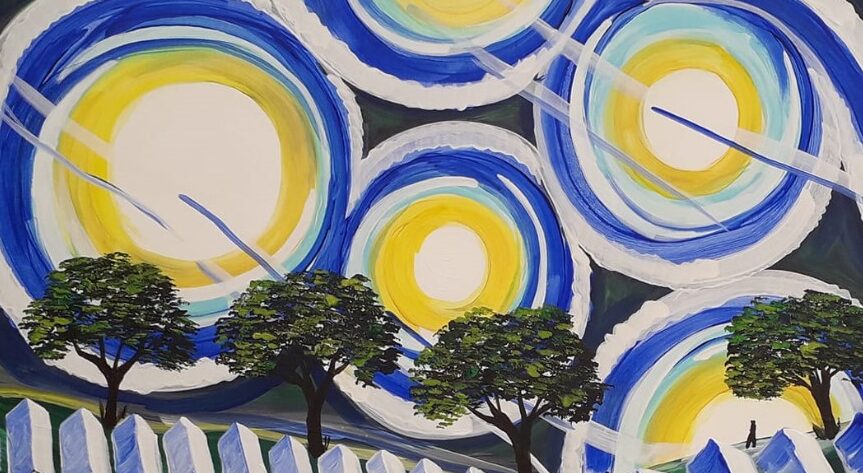
Bairbre Flood: A huge thanks to Fionnuala O’Connell for her beautiful poetry and her insights. Please go and follow her @fionnuala_oco to keep up to date with her future writings. And also her gorgeous paintings and artwork. Fionnuala is another of the performers at our live event this July in Cork, we’ll have digital art by Sylvia Severino, poetry, music, and the first showing of our new poetry films. Also created by Silvio, who you can find at @Loopconspiracy.
Thanks again to the Arts Council of Ireland for funding all this, and thank you for listening from me, Bairbre Flood. Bye for now.
MUSIC